Areas, volumes and the cross product from determinants
Slide 7 used determinants to solve equations. Now we go back to where slide 3 started: areas. A farmer walks around a triangular field with a GPS and writes down its three corners. One 2 by 2 determinant turns those corners into the field's area. In 3D, the three edges of a box give its volume with one 3 by 3 determinant. And 2 by 2 determinants also build a new product of two 3D vectors, the cross product u × v: an arrow that stands at a right angle to both u and v, as long as the area of their parallelogram.
 Lesson 6 · slide 8Cross product
- Area of the parallelogram spanned by u and v: |det [u v]|. The triangle is half of it.
- Use edge vectors (corner minus corner), not the corners themselves.
- Volume of the box with edges u, v, w: |det [u v w]|.
- The cross product u × v is perpendicular to both u and v, and its length is the parallelogram's area.
From corners to area
Subtract the first corner from the other two. That gives two edge vectors, the arrows along two sides of the triangle. Put them in the columns of a 2 by 2 matrix: they make a parallelogram with area |det| (slide 3). The triangle is half of it.
Using the corners themselves measures a different triangle, one with a corner at the origin. The lab asks you to fix that mistake.
Volume of a box
Three edge vectors u, v, w make a slanted box. Its volume is |det [u v w]|, with u, v, w as the columns (slide 3).
Volume 0 means the three edges lie in one plane: the box is flat.
The cross product
For u and v in 3D, the cross product u × v is a new vector at a right angle to both. Write u and v as two rows. Component 1 is the det of columns 2 and 3. Component 2 is minus the det of columns 1 and 3. Component 3 is the det of columns 1 and 2:
A zero dot product means a right angle (lesson 1), so u × v really stands at a right angle to both. Its length is the area of the parallelogram of u and v (take this on trust; the example below checks one case):
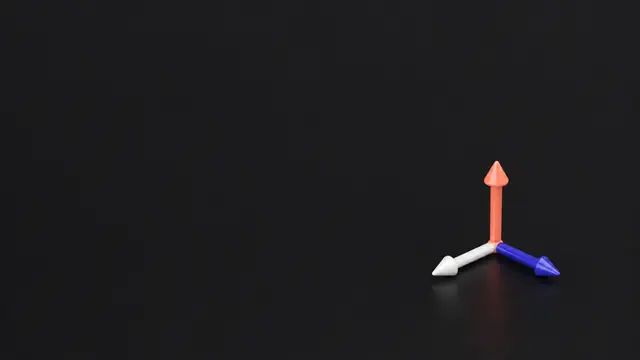
Its direction follows the right-hand rule: curl the fingers of your right hand from u to v, and your thumb points along u × v. Swapping flips it: v × u = −(u × v).
Keep reading with the full course
Finish lesson 6 and you will be able to: see a matrix as a move of the plane, and build one from where two arrows land.
Still locked here:
- The rest of this explanation
- 4 more examples with step-by-step solutions
- Five extra members-only problems with worked solutions
$20 once, lifetime access. Lessons 1 to 3 stay free.
Examples
Example 1 · Torque on a joint
A force F = 130 N acts at r = 200 m from a joint.
Show solutionHide solution
Only the sideways part of the force (3 N, at a 2 m lever) twists the joint: 2 × 3 = 6.
Questions and comments
Stuck on something, or found a mistake? Ask here and I'll answer. You sign in with GitHub.